
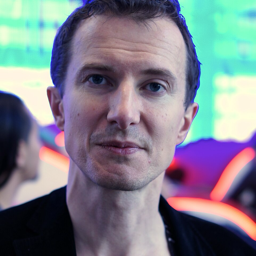
Luke Nosek / Gigafund
Luke Nosek — PayPal co-founder, Founders Fund co-founder (with Thiel and Howery), and the first VC to back SpaceX (2008); SpaceX board member since then. Left Founders Fund in 2017 to start Gigafund (with Stephen Oskoui), a fund built around SpaceX.
The original SpaceX believer — first-check VC in 2008, board member ever since, then founder of Gigafund expressly to keep funding SpaceX (>$1B deployed since 2017). His personal SpaceX stake was valued ~$4.45B at the June 2026 SPCX IPO, with Gigafund's holding 'almost certainly worth more.' Beyond space he sits on the board of AI-hardware firm Luminous Computing and was an early DeepMind board director — a space + AI-compute-hardware profile.
- Not open — Not an open-ended vehicle — analysis only, not an available allocation.
Top holdings
~$4.45B personal. First VC backer (2008), board member; Gigafund put >$1B in since 2017. Now partly public via SPCX (Jun 2026).
long — Board seat at the optical-AI-compute startup — the semiconductor/compute leg of his book.
Early board director before the Google acquisition — long-standing AI-safety/frontier exposure.
Recent moves
SpaceX IPO (Jun 12, 2026, SPCX) crystallized his ~$4.45B personal stake and Gigafund's larger holding into a partly marketable position. Continues on the SpaceX board and the Luminous Computing board.
Our take
Why it matters: the most concentrated SpaceX-conviction individual investor — and his secondary bets (Luminous Computing, DeepMind history) tie him to the AI-compute-hardware layer this page tracks. Edge: 18 years of board-level SpaceX access and a fund purpose-built around the name. Caveats: extreme single-name concentration (now SPCX, exposed to its post-IPO volatility); the $4.45B is a stake valuation, not realized/audited returns; the AI-hardware positions are small private bets disclosed-not-weighted.
The honest read: this is a one-asset story dressed as a fund, and the 'space + AI' framing oversells the AI leg.
Luminous Computing — the AI-hardware bet — laid off half its staff in 2023 and an ex-Luminous photonics team was acquired by AMD in 2025; the DeepMind board seat predates Google's 2014 acquisition. Strip the marketing and Gigafund is essentially all SpaceX. That single bet is spectacular, but it makes attribution impossible: is Nosek a great picker, or did he simply hold the single best access to the single best private company of the era? From the outside the two are indistinguishable — and only one repeats. The Feb 2026 SpaceX/xAI merger folded Musk's AI lab into SpaceX, so any 'AI' exposure is now an artifact of the cap table, not a Nosek thesis. Post-IPO the paper mark is real but the risk changes shape: lockups, Musk-correlation, and SPCX's post-listing volatility now drive it, not private-round step-ups. His access is legitimately disclosed board tenure — a structural edge, nothing more should be read into it.
Thesis
Gigafund is not a diversified fund — it is a purpose-built SpaceX conviction vehicle. Nosek wrote the first institutional check (2008, ~$420M valuation), sat on the board 18 years, then left Founders Fund in 2017 to build Gigafund expressly to keep funding SpaceX (>$1B deployed). The SPCX IPO (priced $135 June 11, debuted June 12, 2026) was the largest ever by funds raised (~$75B), valuing SpaceX ~$1.77T (~$2.1T day-one close) and crystallizing a personal stake the prospectus puts near ~$3.6B (press cites ~$4.45B). The record is one extraordinary bet, not a repeatable process.
Single-name power-law taken to its endpoint: a series of small dedicated vehicles (most recent 'Gigafund 0.14 LP' ~$478M) funneling capital into SpaceX across late rounds, plus a thin tail of ~27 other bets. The edge is board-level access and a 25-year Musk relationship dating to PayPal — not screening, sizing models, or diversification. No style drift: the structure matches the one-name thesis exactly.
Assessment
- Genuine, disclosed structural edge: 18 years on the SpaceX board plus a PayPal-era Musk relationship — access no screen replicates.
- Conviction and hold discipline: sizing the best private asset huge and not trimming captured the full 2008→2026 re-rate (~$420M → ~$1.77T).
- Partial alignment — an extra ~0.07% held via Nosek Capital LLC (which may include other investors) sits alongside his direct stake in the same name.
- Structure matched thesis: small dedicated SPV-like vehicles into one name, no style drift or mandate creep.
- Record is one bet; no evidence of a repeatable, diversified skill — power-law dependence is total, not partial.
- 'Space + AI' is overstated: Luminous faltered (AMD acquired an ex-Luminous team 2025), DeepMind is historical — the AI leg is largely gone.
- Keyman/succession risk: the access-based edge is Nosek personally and does not transfer.
- LP concentration compounds fund concentration — some LPs (e.g. UNC's system, ~10% of endowment) are already heavily SpaceX-linked via Founders Fund vehicles.
- Stake valuation is a moving, unverifiable figure ($3.56B prospectus vs $4.45B press); the fund's own SpaceX holding is never precisely disclosed.
- 2026-07The re-rate was never crystallised into sales: SPCX closed $108.00 on 31 Jul 2026, a ~$1.44T mark — below the $1.77T IPO valuation, under the $135 IPO price, and 52% off the $225.64 June high.
- 2026-07The AI leg now drives the mark rather than sitting as a residue: xAI capex reached $7.7B in Q1, about 3x year-on-year, with up to $120B of 2026-27 burn modelled — the named cause of SPCX's -36% July.
Record
No audited fund IRR or DPI is disclosed — it is a private vehicle. The visible number is a stake valuation, and even that is contested: SpaceX's May 2026 IPO prospectus implies ~0.22% held directly plus ~0.07% via Nosek Capital (~$860M), ~$3.56B total against a ~$2.7B Forbes net-worth estimate; press (Yahoo) cites ~$4.45B; Gigafund's fund-held stake is described as larger but not quantified. All are unrealized-then-newly-marketable marks on a single, still-volatile stock (SPCX priced $135 Jun 11, opened $150, closed ~$161 on day one, ~$2.1T close cap vs ~$1.77T IPO valuation). Until lockups expire and shares are actually sold, this is TVPI on one line item, not realized DPI. Treat the '18-year 10x+' as a paper mark on the era's best cap-table seat, not a demonstrated, diversified return stream.
- 2026-08Lockups are no longer unexpired: the first tranche frees 911.5M shares (~$123B, 64% larger than the $75B IPO) on 6 Aug 2026, two sessions after the 4 Aug Q2 debut, with short interest near 32% of float.
Risks & fit
- Single-stock: SPCX is now essentially the entire mark; any Musk/regulatory/launch-cadence shock hits directly.
- Lockup + liquidity: newly public, so realizations are gated; the mark can move sharply before shares can be sold.
- Musk correlation: personal, political, and cross-company (Tesla/xAI) risk now flows into the SPCX mark.
- Keyman: the access-driven edge is Nosek's alone and does not survive his involvement.
- Valuation opacity: the fund-level SpaceX stake is never precisely disclosed — outsiders cannot verify the figure.
The 'access-and-hold, not repeatable skill' critique is falsified if Gigafund's non-SpaceX book (the ~27 other bets) produces a second, independent power-law winner marked at fund-moving scale — evidence of a process, not one seat. Conversely, the bull case breaks if SPCX de-rates hard post-lockup (Musk-risk, a launch/contract shock, or the xAI-merged AI economics disappointing) and the fund, structurally unable to diversify, rides it down.
A reader studying extreme single-name concentration, board-access edges, and how a 'space + AI' label can mask what is effectively a one-stock SpaceX vehicle. Also a case study in why a spectacular paper mark on a cycle's best private asset is not the same as demonstrated, repeatable manager skill — and in reading a stake valuation (range, lag, unrealized) rather than a point estimate.
Not disclosed — Gigafund is a private VC vehicle with no public fee/carry terms. The VC norm is ~2% management + 20% carry (often higher for single-name access funds), but its specific load and any SpaceX-SPV fee stack are unknown; do not assume.