
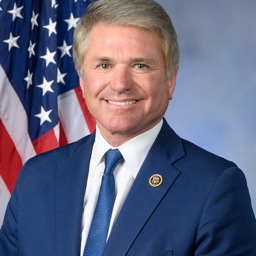
Michael McCaul — disclosures (Semiconductor Caucus co-chair's AI/chip book)
Rep. Michael McCaul (R-TX-10); among the wealthiest in Congress (portfolio >$100M, largely via his wife's Clear Channel family wealth). Co-chair of the Congressional Semiconductor Caucus and member of the AI + Cybersecurity Caucuses. Disclosed via STOCK Act PTRs.
The most on-the-nose policy/portfolio overlap on the page: McCaul literally co-chairs the Semiconductor Caucus and writes chip policy, while trading the exact AI value chain — NVDA, ASML (sole EUV-lithography supplier), and the AI-power names (GE Vernova, Corning) that were primary beneficiaries of the 'Clean AI Energy' proclamations. A huge, high-turnover book ($79.7M 2025 volume, 46 transactions in a single Dec-2025 filing) spanning AI-semi single names, fixed income, and muni-bond ETFs.
- Disclosure record — A public official's statutory filings, not a fund. No NAV, no manager, no terms.
Top holdings

~$1.1M-$1.25M in disclosed transactions — Disclosed ~$1.1M-$1.25M of NVDA activity (incl. partial sales) while championing chip legislation — the headline conflict for a Semiconductor Caucus co-chair.
~$300K (Dec-2025 sales, +31%) — Sold ASML — the world's sole EUV-lithography supplier and the chokepoint of advanced-chip manufacturing — for ~31% gains in the Dec-9 46-transaction filing.

from ~$15K, +152% to +205% — Datacenter-power / grid play; +152% on an Apr-16 lot, cumulatively ~+205% — a direct AI-power-demand beneficiary of the 'Clean AI Energy' initiative.

Cashed out ~$850K of META in 2025 — an AI-mega-cap exit funding the rotation into power/bonds.
PTR range — Optical/datacenter-connectivity supplier; bought alongside GE Vernova as an AI-energy/infrastructure beneficiary.
Recent moves
Dec-9-2025: filed 46 transactions including ASML sales (+31%); 2025 volume ~$79.7M with large exits from Meta and Kraft Heinz and ~$12.2M rotated into municipal-bond ETFs; midyear Global Payments buy ($100K-$250K). Despite chairing the Semiconductor Caucus, his most recent filing showed no new semi/AI/cyber buys — mostly de-risking into bonds (Steven Wang/Capitol Trades, Quiver, Finbold 2026).
Our take
Why it matters: no holder on this page maps more tightly to the AI/semi value chain by mandate and by book — Semiconductor Caucus co-chair trading NVDA, ASML (the EUV chokepoint), and the AI-power complex (GE Vernova, Corning), the exact compute→fab→power chain this surface tracks. Edge/limits: it's a very large, high-turnover, multi-asset book where muni bonds and family wealth dominate the dollars, so the AI-semi names are signal-rich but a minority of the portfolio; recent activity is de-risking, not accumulating. Honest caveat: figures are wide PTR ranges, lagged ~30-45 days, largely spousal/family wealth, and the policy-overlap conflict scrutiny is intense — transparency tracking, explicitly not a recommendation.
What's interesting is what the record maps to thematically: the disclosed equity names trace the compute→fab→power chain — NVIDIA at the accelerator layer, ASML as the EUV-lithography chokepoint, and industrial names levered to data-center electrification.
As a theme map it is one of the more legible AI-value-chain footprints in the congressional disclosure set. As a portfolio it is not legible at all. PTRs report transactions, not positions, so there is no denominator: an NVDA sale disclosed in a band topping out near $1.2M tells you nothing about what remains. The fixed-income and muni activity, which likely dominates the dollars, is invisible to ticker-level trackers indexed on equities. A single July 2025 filing disclosed roughly $18M of bundled activity — the scale at which single-name inference stops working. The filing tells you these instruments were transacted. It does not tell you position size, weighting, holding period, or who directed the trade.
- 2026-04The chip-chain map is being exited, not held: ASML was sold in Dec 2025 and on 15 Jan 2026, GE Vernova on 29 Apr 2026. The 2026 tape runs to Mastercard, S&P Global, Intuit, Teradyne, Danaher and Workday.
Thesis
A congressional disclosure record, not a fund. Rep. Michael McCaul (R-TX-10) files STOCK Act periodic transaction reports covering a large family portfolio — associated with Clear Channel wealth, his wife being the daughter of a Clear Channel co-founder — trading across AI-semiconductor names (NVDA, ASML), industrials tied to data-center power, and a substantial fixed-income and municipal-bond sleeve. The filings show transaction flow in value ranges: not a portfolio, not a NAV, not a return.
As reported: high-cadence multi-asset activity, often dozens of transactions per filing, spanning AI/semi equities, financials, healthcare and payments names, plus bonds and muni ETFs. Disclosed tickets span the standard bands from $1,001–$15,000 upward, with several reported in six- and seven-figure bands. Filings routinely bundle purchases and sales of the same sector in one report. Cadence is filing-driven, so activity appears in clusters rather than evenly.
Assessment
- The AI-value-chain names cluster coherently — accelerator, lithography chokepoint, and power/materials are the three layers a compute-buildout theme would actually touch.
- Filing cadence is high and itemized; individual reports detail dozens of transactions with per-ticket date and value range.
- The book is genuinely multi-asset: fixed income and municipal ETFs appear alongside the equity names.
- Reported 2025 volume ranges roughly $58M–$76M across trackers; Finbold, citing Capitol Trades, ranked him second at $75.5M.
- PTRs report value RANGES ($1,001–$15,000, $15,001–$50,000, and up), never amounts. Any single-figure 'position size' is a tracker's midpoint assumption, not disclosure.
- Statutory filing lag runs roughly 30–45 days, so every reported trade is already stale on publication. This is the mechanics of the regime, applying identically to all filers.
- Much of this wealth is family in origin. A spouse's or trust's holding is the spouse's or the trust's, and the filing does not disclose who directed any given trade.
- No denominator exists. Transactions are disclosed; positions and total portfolio value are not, so 'weight' in any holding cannot be derived from PTRs.
- Tracker reconstructions diverge materially — even on 2025 volume, where two Capitol Trades-sourced tallies differ by roughly $18M. Cross-check against the House Clerk filing.
- 2026-07The three layers did not move as one theme in July 2026: Nvidia +0.3% while ASML -18.1%, GE Vernova ~-16% and Corning ~-46%, the latter on its worst session since 2002 on 28 Jul. Only the accelerator held.
- 2026-07The $75.5M second-place volume ranking is a 2025 figure. July 2026 coverage puts family trading at ~$48M across 980 trades over the trailing year — a different and materially smaller window.
Record
There is no published portfolio return, because PTRs cannot produce one — no starting balance, no ending balance, no position sizes. Third-party trackers (Capitol Trades, Quiver, Unusual Whales) publish per-trade 'estimated return' figures by pairing a disclosed buy with a later price or sale, using range midpoints as the size assumption. Those estimates inherit every limitation above: they benchmark a guessed size against a guessed entry, ignore the fixed-income sleeve, and cannot see positions never transacted in the window. Even reported VOLUME diverges: Finbold, citing Capitol Trades, placed him second in Congress for 2025 at $75.5M, while another Capitol Trades-sourced tally for the same period placed him first at $57.7M. Volume is at least checkable against filings; return is not.
Risks & fit
- The disclosed equity names concentrate in a single macro theme — AI capex — so they would move together in a data-center spending slowdown.
- ASML exposure carries single-chokepoint and export-control sensitivity; policy shifts on lithography tooling hit it directly.
- The muni/fixed-income sleeve is duration-exposed to rate moves, and is the part ticker-indexed trackers systematically fail to capture.
- Semi single names carry high realized volatility, so range-based reconstructions of them are especially wide.
This reading — that the disclosed book is an AI-value-chain theme map sitting inside a much larger, bond-heavy family portfolio — would change if a full annual OGE-278e disclosure (which reports HOLDINGS, not just transactions) showed the equity sleeve dominating total assets rather than the fixed-income sleeve, or showed the semi names as trivial residual positions. It would also change if subsequent filings showed the AI-chain names being rebuilt at scale rather than trimmed. The 278e is the document that answers what the PTRs cannot.
Useful as market-structure and theme context: which layers of the AI compute chain show up together in a large disclosed book, and how a muni/fixed-income sleeve sits alongside them. Also a worked example of what STOCK Act data can and cannot support. It is NOT a signal to mirror — the lag, value ranges, missing denominator and spousal/trust attribution make trade-level replication unsound. Nothing here is investment advice.
Not applicable — a public official's disclosure record, not a managed vehicle. No fund, no fee schedule, no outside capital, and no way for a reader to invest alongside it.