
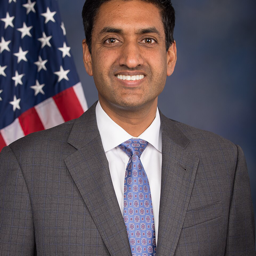
Ro Khanna — household disclosures (Ritu Khanna trust: NVDA & AI book)
Rep. Ro Khanna (D-CA-17, Silicon Valley); states he does not personally trade — ~99% of disclosed household assets sit in a trust controlled by his wife, Ritu Khanna (family wealth via Transtar Industries). Disclosed via STOCK Act / House financial disclosures.
The highest-octane AI book of the congressional cohort, and the most pointed conflict story: Khanna represents Silicon Valley, is ranking member of the Select Committee on the CCP (which shapes advanced-chip export controls to China) and sits on Armed Services CITI (defense-AI procurement) — while his household trust trades NVIDIA repeatedly. Quiver flags him the most active House Democratic trader (~$210M volume, tens of thousands of trades). The signal is concentrated in the AI-compute names (NVDA core, plus Micron, Alphabet, Microsoft), wrapped in a broad multi-sector book (defense primes, energy, pharma).
- Disclosure record — A public official's statutory filings, not a fund. No NAV, no manager, no terms.
- Reconstructed — Figures are third-party estimates rebuilt from filings, not reported results.
Top holdings

$100K-$250K bracket (+~143% on the Feb-2024 lot) — Flagship position — Ritu Khanna's trust opened NVDA Feb-2024 and added on ~10 further occasions through 2025 (incl. a May-2025 $15K-$50K buy up >50%). The single most-cited congressional AI windfall after Pelosi.

PTR range (trust) — Memory/HBM supplier to the AI-compute stack; named among the trust's semiconductor exposure.

PTR range (trust) — Hyperscaler / AI model + TPU exposure; part of the household AI book.

PTR range (trust) — AI-capex / hyperscaler proxy held in the trust.

PTR ranges (trust) — Lockheed, Raytheon, Northrop, General Dynamics, Leidos — defense-AI-adjacent and conflict-flagged given his Armed Services CITI seat; not pure AI/semi but part of the disclosed book.
Recent moves
Trackers report ~3,000+ trades totalling ~$50M in 2025 alone across the household trust, including continued NVDA accumulation. The China-select-committee + Silicon Valley-district overlap with active chip trading has made him a focal point in the 2026 congressional-trading-ban debate; Khanna (a trading-ban co-sponsor) maintains the trust is his wife's and managed without his involvement (Quiver, Kapitol.ai, Newsweek 2026).
Our take
Why it matters: this is arguably the page's purest AI-compute political book — NVDA is the anchor, surrounded by Micron/Alphabet/Microsoft, exactly the value chain tracked here, and uniquely conflict-laden given Khanna's CCP-select-committee role over the export-control regime that moves those very chips. Edge/limits: the trust structure hides real-time weights and precise sizing; the eye-popping outperformance is a contested tracker estimate over a cherry-picked AI sleeve, not the whole book. Honest caveat: figures are wide PTR ranges, lagged ~30-45 days, held in a spouse's trust he says he doesn't control — transparency tracking, explicitly not a buy signal or endorsement.
The disclosed book maps onto themes tracked elsewhere here: the AI-compute chain (accelerators, memory, hyperscalers) inside a diversified large-cap sleeve with defense, pharma and energy ballast.
NVIDIA draws the most attention — a February 2024 trust purchase is reported in a $100,001–$250,000 transaction-value bracket (the bracket is the size of the trade, not a filed gain), with roughly ten subsequent adds through 2025; the widely-quoted ~143% return on it is a third-party price-derived estimate, not a disclosed figure. What the filing lets a reader conclude: which tickers were transacted, in which direction, within a value band, on an approximate date. What it does not: position sizes, weights, cost basis, cash, or what share of the household's ~$36.4M–$101.5M of 2023 reportable assets any name represents. Disclosure exists for transparency of activity, not portfolio reconstruction.
Thesis
Not a fund — a household disclosure record. Rep. Ro Khanna (D-CA-17) states he does not personally trade; effectively all disclosed household securities sit in a family trust associated with his wife, Ritu Khanna. The filings show a large, high-turnover, multi-sector US equity book whose most-discussed sleeve is AI compute — NVIDIA foremost — reported in statutory value ranges, not positions.
As reported: broad single-name US equity at high cadence. Third-party reconstructions count ~12,000+ disclosed trades over roughly three years, ~$210M gross volume across ~879 issuers. Clusters: AI/semis (NVDA, MU, GOOGL, MSFT), defense primes (LMT, RTX, GD, HON), pharma (ABBV, JNJ, HUM), energy (XOM, CVX, PSX). Periodic transaction reports give direction plus a value band, not weights.
Assessment
- The AI sleeve is the full compute stack — accelerator (NVDA), memory (MU), hyperscale demand (MSFT, GOOGL) — rather than a single ticker
- Breadth is real: ~879 distinct issuers across at least four sectors, so the AI names sit inside a diversified book
- Attribution is unusually explicit — the trust and its origin are named in the filings and in Khanna's own public statements
- Cadence is consistent across years rather than episodic, which makes tracker reconstruction comparatively data-rich
- Filings report VALUE RANGES ($1,001–$15,000, $100,001–$250,000, etc.), never exact amounts — no position size is knowable, and a bracket is a trade size, not a gain
- STOCK Act periodic reports arrive on a statutory lag (30 days from notification, no later than ~45 days from transaction); this is a neutral feature of the regime
- Assets are held in a spouse-associated family trust, not a qualified blind trust — attribution is household, not the member personally
- No denominator: transactions are disclosed without total portfolio value, so 'weight' and 'concentration' cannot be computed from the filing
- Reconstructions demonstrably disagree — two published estimates from the same filings reach opposite conclusions on performance
Record
Two reconstructions of the same filings disagree. ProCap Insights, cited by Newsweek, estimates trades associated with Khanna returned ~112.1% in excess of the S&P 500 from January 2024 to April 2026. PoliticalWallet, using Unusual Whales data, computes trust returns trailing SPY each year: 12.7% vs 24.8% (2023), 19.1% vs 24.9% (2024), 12.6% vs 16.8% (2025). The divergence is method-driven: the two differ in benchmark basis, in whether they model a transaction series (entry size assumed from disclosure ranges) or a holdings series, and in window — ProCap's begins near the base of the 2024–2026 AI-compute rally. No official return, NAV or time-weighted series exists for a household disclosure record; both figures describe a model of the disclosed trades. Neither is attributable to skill, and we make no claim either way.
Risks & fit
- Concentration of the disclosed AI sleeve in one capex theme — accelerator demand, memory pricing and hyperscaler spend co-move
- Semiconductor names in the book are exposed to advanced-chip export-control policy, which shifts the addressable China market
- Defense-prime exposure is budget-cycle dependent — appropriations timing and program cancellations drive those names
- High turnover means the reported snapshot may not reflect current positioning by the time a reader sees it
- Broad single-name breadth (~879 issuers) carries idiosyncratic event risk that no summary of top names captures
Independent reconstructions already diverge — ProCap's +112% excess and PoliticalWallet's three straight years of SPY underperformance come from the same filings — so any single performance number should be read as model output, not fact. This reading would further change if: (a) the trust converted to a qualified blind trust or disclosed weights, replacing inference with actual sizing; (b) later filings showed the AI-compute cluster substantially reduced or rotated, undercutting the 'AI-anchored book' description; or (c) amended filings revised the transaction record itself.
Readers using disclosure data as market-structure and theme context — which sectors show up in high-cadence household books, how AI-compute exposure is expressed across a value chain, and how the STOCK Act reporting regime works in practice. It is a transparency record, not a signal. It is not a portfolio to mirror, it is not tradeable (ranges and lag preclude it), and nothing here is investment advice.
No fund, no fee structure, no external capital — a household disclosure record, not an investable vehicle.