
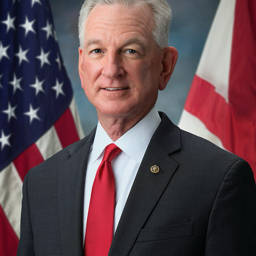
Tommy Tuberville — disclosures (high-frequency mega-cap tech trader)
Sen. Tommy Tuberville (R-AL); states his money is with 'financial people' and is NOT in a blind trust. Disclosed via STOCK Act PTRs.
Volume over conviction: Tuberville is among the single most active traders in Congress, churning the AI mega-cap complex (Alphabet, Apple, Microsoft, Oracle) in $15K-$100K clips rather than holding concentrated single-name bets. The 2025 signal is a rotation — selling down the AI-software/mega-cap names through late 2025 and rebalancing into defensive sector ETFs (utilities XLU, staples XLP, healthcare XLV), a 'taking-chips-off-the-table' tell from a heavy tech trader. ~+15.6% 2025 portfolio return (tracker estimate, ranked ~32nd in Congress).
- Disclosure record — A public official's statutory filings, not a fund. No NAV, no manager, no terms.
- Reconstructed — Figures are third-party estimates rebuilt from filings, not reported results.
Top holdings

$15K-$50K (sold Nov-2025 & Dec-2025/Jan-2026) — Hyperscaler / AI model + TPU name; repeatedly traded, most recent disclosed action a Dec-2025 sale — part of the late-20

$50K-$100K (Jan-2026 sale) — AI-device/edge-compute proxy; sold a $50K-$100K lot Jan-2026 after an earlier $15K-$50K sale Nov-2025.

$15K-$50K (Nov-2025 sale) — AI-capex / hyperscaler proxy; trimmed in the Nov-2025 filing.

$15K-$50K (Nov-2025 sale) — OCI cloud / AI-datacenter buildout name; sold in the Nov-2025 tech-reduction batch.

$15K-$50K each (Dec-2025 buys) — Utilities / consumer-staples / healthcare ETFs bought Dec-2025 — the rotation OUT of mega-cap tech; XLU is also an indir
Recent moves
Nov-2025→Jan-2026 filings show a consistent sell-down of the AI mega-caps (GOOGL, AAPL, MSFT, ORCL) in $15K-$100K lots, paired with Dec-2025 purchases of defensive sector ETFs (XLU, XLP, XLV) — a rotation from growth/tech into defensives. A CNN Feb-2026 analysis flagged senators (Tuberville among them) trading in industries their committees regulate (MarketBeat, Quiver, CNN 2026).
Our take
Why it matters: Tuberville is the page's window into how a hyper-active congressional trader handles the AI mega-caps — he holds the same compute/cloud names (GOOGL, AAPL, MSFT, ORCL) but as trading inventory, and his late-2025 rotation into defensive ETFs is itself a signal about positioning at the top of the AI cycle. Edge/limits: tiny position sizes ($15K-$100K) and ~1,040 trades mean this is signal-on-names, noise-on-dollars; not a blind trust, so committee-overlap conflict scrutiny applies. Honest caveat: figures are wide PTR ranges, lagged ~30-45 days, executed by his financial managers — transparency tracking, explicitly not a buy recommendation.
Read chronologically, the disclosed book shows episodic rotation rather than one continuous path.
April 15, 2025 (filed May 15): BMY and PYPL sold, and USIG — an investment-grade corporate bond ETF — bought at $50,001–$100,000. December 17, 2025 (filed January 2026): AAPL sold at $50,001–$100,000 and GOOGL at $1,001–$15,000, with XLU, XLP and XLV each bought at $15,001–$50,000. June 8–9, 2026 (filed July 16): eleven sales spanning the dividend-and-infrastructure sleeve — PG, PFE, NEE, DUK, AWK, CSX, WAB, LMT, MA, ACN, TSCO. So the credit purchase came fourteen months BEFORE the move into defensive sector ETFs, and those defensives were themselves sold about six months after being bought. The filings support that sequence of dated transactions. They cannot support a motive, a total allocation, or where proceeds went — PTRs report transactions, not balances, and carry no explanatory field.
Thesis
Not a fund — a STOCK Act disclosure record. Sen. Tommy Tuberville (R-AL) files Periodic Transaction Reports covering assets he states are managed by outside financial professionals and are not held in a blind trust. MarketBeat logs 1,042 lifetime transactions across 266 companies and $30.65M of disclosed volume (accessed 2026-07-22); Benzinga puts activity since 2021 near $38M, with 2025 volume down to roughly $1.1M. Every figure is a value RANGE reported after a statutory lag — never an amount, never a balance.
As reported: single-name equities plus sector and bond ETFs, transacted mostly in the $1,001–$15,000 and $15,001–$50,000 bands, with occasional larger clips. Breadth over concentration — hundreds of names rather than a few sized bets. Cadence is episodic: clusters of tickers traded on one or two consecutive dates, then quiet stretches. Disclosed sales volume exceeded buy volume in each of 2023, 2024 and 2025, and 2026 filings continue in that direction.
Assessment
- Coverage is dense: frequent filings across five years give an unusually continuous dated time series for a personal disclosure record.
- Breadth is high — 266 companies traded — so no single disclosed name is load-bearing in the record.
- MarketBeat records the June 2026 disposals under the filing's full-sale designation across all eleven names.
- Instrument mix is legible: large-cap single names alongside broad sector and bond ETFs, both plainly identifiable.
- Value RANGES only. A $15,001–$50,000 sale is a band; summing bands yields a range, not a total.
- Filing lag is statutory, roughly 30–45 days. The June 8–9 sales were filed July 16. Lag is a mechanic of the regime, not a signal.
- No denominator. PTRs disclose transactions, not total assets, so weights and portfolio share cannot be computed.
- Attribution matters: reportable assets may be self, spouse, joint or trust-held, and Tuberville states outside managers execute. Filer is not necessarily decision-maker.
- Trackers reconstruct holdings from disclosed trades plus annual filings; MarketBeat, Quiver and Benzinga report different totals for the same record.
Record
No official return exists and none can be derived from the filings. Third-party trackers publish reconstructed return estimates for congressional filers, but any such figure is an estimate rather than an audited result — there is no NAV, no cash-flow timing, and no accounting for assets outside PTR scope. Media coverage sometimes reports how a stock has moved since a disclosed trade date; that measures the security, not the filer's realised outcome, since neither entry price nor position size is disclosed. Every reconstruction is bounded by the same three limits: value bands instead of amounts, a 30–45 day reporting lag that blurs execution timing, and the absence of a denominator. Treat such figures as estimates with wide error bars, and never as evidence about skill in either direction.
Risks & fit
- Disclosed exposure has shifted toward credit and away from equity, making the reported book more sensitive to rate and spread moves than to earnings.
- Selling AAPL and GOOGL in December 2025 removed disclosed exposure to the mega-cap complex that led index returns in that period.
- The June 2026 disposals leave the disclosed equity footprint thinner and less diversified across utilities, staples, healthcare and industrials.
- High turnover means any snapshot decays quickly — a reading is already stale by the length of the filing lag.
- Assets outside PTR reporting scope mean disclosed exposure may not represent the whole balance sheet.
This reading — episodic rotation with no single directional path — would be overturned by subsequent PTRs showing a sustained one-way pattern: material re-entry into the mega-caps sold in December 2025, or continuous credit accumulation rather than the isolated April 2025 USIG purchase. An annual OGE-278e report revealing large holdings never transacted, and so never appearing in PTRs, would also change the picture. So would disclosure of a blind trust, or of proceeds redeployed outside PTR scope — either would mean the clusters reflect administrative reorganisation, not shifts in exposure.
Useful as theme and market-structure context: a dated public record of when one disclosed book moved through mega-cap tech, investment-grade credit, and defensive sector ETFs. It is NOT a signal to mirror — value bands, the 30–45 day lag, the absent denominator, and third-party execution make replication impossible, and prices already reflect the filings. Disclosure transparency, not investment advice.
Not applicable — there is no fund, no NAV, no management or performance fee, and no outside capital. This is a public official's statutory disclosure record, not an investable vehicle.